
Modern texting is full of short abbreviations that can easily confuse people who are not familiar with online slang. Sometimes a simple three-letter message appears in a conversation and suddenly the meaning of the whole discussion becomes unclear. Many people experience this when they see IDT meaning in text while chatting with friends, messaging someone on social media, or reading comments online.
The difficulty comes from the fact that short abbreviations often depend heavily on context. The same letters can signal agreement, disagreement, uncertainty, or even emotional distance depending on how they are used in a conversation.
Understanding the IDT meaning in text requires more than just memorizing a definition. It also involves recognizing the tone, the intent behind the message, and the situation where the abbreviation appears. Once you understand how IDT works in digital communication, it becomes much easier to interpret conversations accurately and respond in a natural way.
Quick Answer Box
| Abbreviation | Most Common Meaning | Other Meanings | Tone | Commonly Used On | Safe For Work | Quick Tip |
|---|---|---|---|---|---|---|
| IDT | I Don’t Think | I Don’t Talk, I Don’t Trust (rare) | Neutral, uncertain, sometimes dismissive | Text messages, Snapchat, TikTok, Discord | Yes | Usually expresses doubt or disagreement |
What Does IDT Mean In Text?
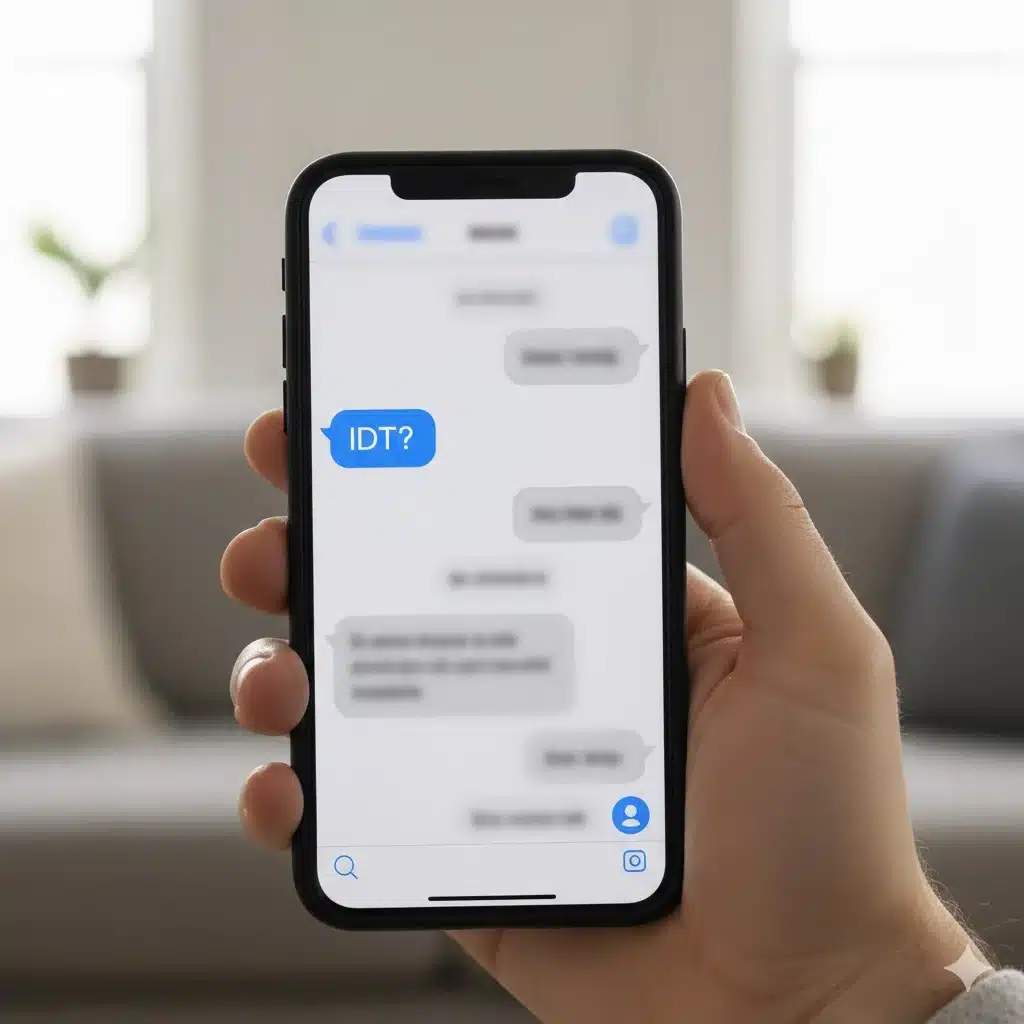
IDT stands for “I Don’t Think.”
Linguistically, IDT functions as an abbreviated cognitive expression, meaning it communicates a person’s thought, opinion, or uncertainty in a condensed form. Instead of typing a full sentence like “I don’t think that’s correct” or “I don’t think I can come,” people shorten the phrase to IDT to make texting faster.
The semantic core meaning of IDT revolves around doubt, hesitation, or mild disagreement. It signals that the sender does not believe something is true, likely, or correct.
Socially, IDT acts as a soft disagreement marker. Rather than directly rejecting someone’s idea, it allows a person to express uncertainty in a casual and less confrontational way.
Because texting culture values speed and brevity, abbreviations like IDT spread globally through messaging apps, gaming chats, and social platforms.
However, its exact meaning always depends on context, tone, and conversation flow, which is why understanding how IDT is used in real communication is important.
Most Common IDT Meaning In Text
The most common meaning of IDT is “I Don’t Think.”
This meaning appears when someone wants to express doubt about something that was said earlier in a conversation.
The conversational trigger usually happens when another person suggests something, asks a question, or makes a claim. The person replying uses IDT to indicate they believe the statement might not be correct or likely.
Example:
Friend: “Do you think the meeting will be canceled?”
Reply: “IDT so.”
In this example, IDT signals uncertainty rather than strong disagreement. The speaker is not aggressively rejecting the idea but expressing their opinion that it probably will not happen.
Socially, this abbreviation often signals casual disagreement or cautious thinking.
Common IDT Meaning
Another common use of IDT is to express uncertainty about plans or decisions.
People use it when they are not sure about something but want to communicate their current opinion quickly.
Example:
Friend: “Are you coming to the party tonight?”
Reply: “IDT I can make it.”
In this case, IDT communicates hesitation or doubt about availability. It suggests that the person currently believes they cannot attend, but the tone is not overly final or harsh.
The abbreviation helps keep the conversation informal and efficient.
Less Common IDT Meaning
In some conversations, IDT can be interpreted as “I Don’t Trust.”
This meaning appears mostly in discussions about people, rumors, or suspicious situations.
Example:
Friend: “You should believe everything he says.”
Reply: “IDT him honestly.”
Here, IDT signals skepticism or distrust toward a person.
This usage is less common because people usually write the full phrase “I don’t trust,” but some users still shorten it in casual chats.
Rare IDT Meaning
A rare interpretation of IDT is “I Don’t Talk.”
This meaning appears in specific online communities or gaming environments where someone wants to indicate they are not using voice chat.
Example:
Player: “Why aren’t you on voice?”
Reply: “IDT much during matches.”
In this case, the abbreviation signals a personal communication preference rather than disagreement.
Because this usage is uncommon, most readers will interpret IDT as “I don’t think” unless the context clearly suggests otherwise.
Origin And Evolution Of IDT
The abbreviation IDT emerged from early texting culture in the late 1990s and early 2000s when mobile messaging was limited by character counts and slower typing speeds.
During that period, users created many short forms such as “IDK,” “IMO,” and “BRB” to reduce typing effort.
IDT fits into the category of cognitive shorthand, abbreviations used to express thoughts or opinions quickly.
As social media expanded, these abbreviations spread across platforms like instant messaging apps, gaming chats, and online forums.
Today IDT continues to appear in casual messaging environments where speed and conversational efficiency are valued.
Psychological And Emotional Meaning Of IDT
Psychologically, IDT represents a soft cognitive boundary in communication.
Instead of directly rejecting an idea, the phrase “I don’t think” allows someone to express disagreement in a way that feels less confrontational.
This subtlety is important in digital conversations because text lacks vocal tone and body language.
Using IDT helps people signal:
• uncertainty
• hesitation
• polite disagreement
• cautious thinking
For example:
“I think that rumor is true.”
“IDT it is.”
The response communicates skepticism while avoiding an aggressive tone.
Communication Function Of IDT
In conversation, IDT performs several communication roles.
First, it acts as a disagreement buffer. Rather than saying “You’re wrong,” someone might say “IDT that’s right.”
Second, it works as a thinking marker, showing that the speaker is considering information rather than reacting emotionally.
Third, it helps maintain conversational flow. The abbreviation keeps messages short and quick in fast-paced chats.
Cultural And Generational Context Of IDT
IDT appears most frequently among younger digital users, including teenagers and young adults who grew up with texting slang.
However, it is not restricted to any single age group. Anyone familiar with online abbreviations may use it in casual messaging.
Different cultures and language backgrounds adopt English texting slang at different speeds, but abbreviations like IDT spread globally through social media platforms.
Why IDT Became Popular
Several factors contributed to the popularity of IDT.
Short abbreviations reduce typing effort, especially on mobile devices.
They also create a casual conversational style that fits modern messaging environments.
Another reason is emotional efficiency. IDT lets someone disagree without sounding overly direct, which helps avoid conflict in text conversations.
Semantic Core Meaning Of IDT
At its core, IDT communicates cognitive uncertainty or disagreement.
The phrase signals that the sender’s current belief does not align with what was suggested.
However, the tone often remains moderate rather than confrontational.
Most Common IDT Meaning In Text (Deep Dive)
What It Means
In most conversations, IDT expresses a quick opinion that something is unlikely or incorrect.
It functions as a short form of “I don’t think so” or “I don’t think that’s right.”
The tone usually depends on context and punctuation.
Typical Use Cases
Someone questions a claim:
Friend: “The store closes at 8.”
Reply: “IDT it does, I think it’s 9.”
Someone discusses plans:
Friend: “Can we finish this tonight?”
Reply: “IDT we have enough time.”
Someone reacts to a rumor:
Friend: “I heard he quit his job.”
Reply: “IDT that’s true.”
Examples In Different Tones
IDT so.
IDT that’s right.
IDT it will happen today.
IDT that was the problem.
IDT we should do that.
What It Can Sound Like
Polite disagreement
“IDT that’s the correct answer.”
Uncertain thinking
“IDT it’s finished yet.”
Dismissive tone
“IDT anyone cares about that.”
Neutral opinion
“IDT that’s necessary.”
Meaning Based On Context
Positive Use
Sometimes IDT softens disagreement so the conversation stays friendly.
Example:
“I thought the movie was boring.”
“IDT it was boring, I actually liked it.”
The tone remains respectful rather than confrontational.
Neutral Use
In neutral situations, IDT simply communicates an opinion without emotional weight.
Example:
“Is the store open today?”
“IDT it is.”
Negative Or Critical Use
If written bluntly, IDT may sound dismissive.
Example:
“You should believe that story.”
“IDT so.”
The lack of explanation can make the message appear abrupt.
Dry Or Rushed Use
Short responses like “IDT” alone may signal that the sender is busy or not interested in elaborating.
Example:
“Do you think that idea will work?”
“IDT.”
How IDT Is Used In Real Conversations
Understanding Or Clarifying
Someone corrects information.
Example:
“I think the event starts at noon.”
“IDT it does. I saw 2 PM.”
Reacting Or Labeling
A person expresses doubt about a statement.
Example:
“He said he finished the project.”
“IDT that’s accurate.”
Social Or Dating Context
People sometimes use IDT when declining plans.
Example:
“Want to meet tonight?”
“IDT I can, I’m busy.”
Group Or Online Context
In group chats, IDT helps share quick opinions.
Example:
“Should we change the plan?”
“IDT we need to.”
Gaming Context (If Relevant)
Players use IDT to disagree about strategy.
Example:
“Attack now.”
“IDT that’s a good move.”
IDT Meaning On Different Platforms
IDT Meaning On Snapchat
On Snapchat, IDT usually appears in short replies when responding to quick questions.
Example:
“Do you think she saw the message?”
“IDT.”
IDT Meaning On TikTok
In comments, IDT often expresses disagreement with a video claim.
Example comment:
“IDT that’s how this works.”
IDT Meaning On Instagram
Instagram users write IDT in replies or direct messages.
Example:
“Do you think that rumor is real?”
“IDT it is.”
IDT Meaning In Texting Or Messaging
In standard texting, IDT frequently replaces full sentences like “I don’t think so.”
Example:
“Will it rain today?”
“IDT.”
IDT Meaning On Discord Or Communities
In online communities, IDT helps people express quick opinions during discussions.
Example:
“Is that update coming tonight?”
“IDT so.”
When To Use Vs When To Avoid IDT
When To Use
Casual conversations with friends often include abbreviations like IDT because they keep messages short and informal.
Example:
“Will he join us later?”
“IDT.”
When To Avoid
Professional emails or formal discussions should avoid slang abbreviations.
Example:
Instead of “IDT this plan works,” write “I don’t believe this plan will work.”
Professional And Safe Alternatives
More formal alternatives include:
“I don’t think so.”
“I’m not sure that’s correct.”
“I believe that might be inaccurate.”
Hidden Or Risky Meanings Of IDT
In most cases, IDT is harmless. However, the tone can become dismissive if used without explanation.
Example:
Person: “I worked hard on this idea.”
Reply: “IDT it’s good.”
The message may sound overly blunt if not followed by a reason.
Variations And Forms Of IDT
IDTS
Tone: Stronger certainty
Example: “IDTS that’s true.”
IDT SO
Tone: Mild disagreement
Example: “IDT so.”
id t
Tone: Casual typing variation
Example: “id t that will happen.”
IDT Vs Similar Slang
IDT vs IDK
IDT expresses doubt about a statement.
Example: “IDT that’s correct.”
IDK expresses lack of knowledge.
Example: “IDK the answer.”
IDT vs IMO
IDT rejects or doubts something.
IMO shares a personal opinion.
How To Decode The Correct Meaning
- Look at the previous message in the conversation.
- Identify whether the sender is responding to a question or claim.
- Check the tone of surrounding messages.
- Consider whether the abbreviation signals disagreement or uncertainty.
- Read the sentence structure to determine the intended meaning.
How To Respond To IDT
Casual Replies
“Maybe you’re right.”
“Yeah, you could be correct.”
Friendly Replies
“Why don’t you think so?”
“That’s interesting, tell me more.”
Mature Or Respectful Replies
“I understand your point. What makes you think that?”
Boundary Or Privacy Responses
“I’d rather not discuss that.”
“Let’s move to another topic.”
Common Misunderstandings About IDT
One common misunderstanding is assuming IDT always signals strong disagreement. In reality, it often indicates mild uncertainty rather than rejection.
Another confusion occurs when people mistake it for “IDK,” which means something entirely different.
Regional And Cultural Usage Of IDT
English texting slang spreads globally through social media platforms, gaming communities, and messaging apps.
While IDT originated in English-speaking environments, it now appears in conversations worldwide where people use English for online communication.
Read: salad jokes
Read: XFree Explained
Read: What Does DTM Meaning In text?
Read: Mummy Jokes
Read: What Does GNG Mean
Frequently Asked Questions
What Does IDT Mean In Text?
IDT usually means “I don’t think.” It expresses doubt or disagreement in a short texting abbreviation.
Is IDT The Same As IDK?
No. IDT means “I don’t think,” while IDK means “I don’t know.”
Is IDT Rude?
Not necessarily. It depends on tone and context. With explanation, it usually sounds neutral.
Can IDT Mean Something Else?
Rarely, it may mean “I don’t trust” or other interpretations, but these are uncommon.
Is IDT Safe For Work?
Yes. The abbreviation is generally appropriate for normal conversations.
Do People Use IDT On Social Media?
Yes. It commonly appears in texting, social media comments, and chat platforms.
Conclusion
Understanding the IDT meaning in text helps make online conversations clearer and easier to interpret. In most situations, IDT simply stands for “I don’t think,” allowing people to express doubt, disagreement, or uncertainty quickly during casual messaging.
Like many texting abbreviations, the meaning depends heavily on context. The tone can range from polite disagreement to neutral opinion depending on how the phrase is written and the surrounding conversation.
Recognizing how IDT functions socially, emotionally, and linguistically allows readers to decode messages more accurately and respond in a natural way. Once you understand the IDT meaning in text, conversations that once seemed confusing become much easier to follow.